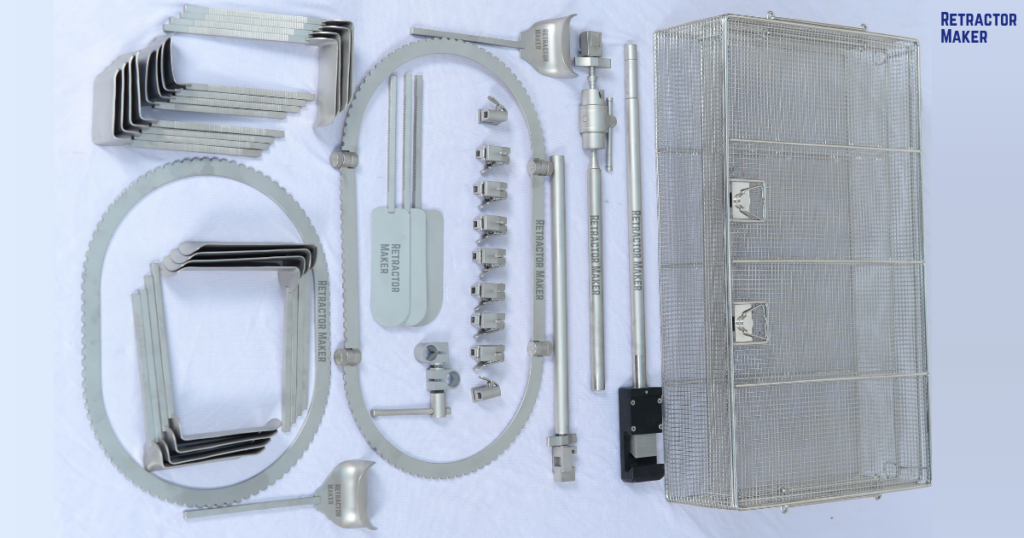
Bookwalter Retractor vs Thompson Retractor: Complete Comparison Guide
Selecting the optimal table-mounted self-retaining retractor platform is a critical operational decision for surgical directors, operating room managers, and hospital procurement teams. The Bookwalter Retractor System and the Thompson Retractor System represent the two leading mechanical frameworks in open surgical retraction. While both systems clamp directly to operating table side rails to deliver hands-free tissue tension, they utilize fundamentally different engineering philosophies: the Bookwalter relies on a single-post vertical column supporting a circumferential perimeter ring frame and quick-clip notched ratchets, whereas the Thompson utilizes a dual-clamp bilateral crossbar frame with micro-adjustable handles and cam clip-on joints. This evidence-based guide provides a detailed technical comparison of both platforms across hardware specifications, setup steps, blade mechanics, and specialty applications.
Introduction
In major open surgical procedures—including exploratory laparotomies, deep pelvic mass resections, open nephrectomies, and abdominal aortic aneurysm repairs—maintaining static, clear visual exposure is essential. Relying on surgical assistants or scrub technicians to hold handheld manual retractors for extended periods introduces physical muscle fatigue, subtle hand tremors, uneven traction force, and physical crowding around the surgical site.
Table-mounted self-retaining retractor systems eliminate these operational challenges by anchoring the mechanical force of tissue retraction directly to the operating table side rail. Across global healthcare facilities, the Bookwalter Retractor System and the Thompson Retractor System serve as the primary workhorse platforms for major open surgery.
While both systems share the clinical objective of hands-free, reliable wound clearance, they employ distinct structural mechanisms:
- The Bookwalter System centers around a rigid circumferential ring frame (oval or hinged segmented) suspended overhead from a single field post and horizontal flex bar, utilizing notched handle shanks locked by spring-loaded ratchets.
- The Thompson System utilizes a bilateral dual-clamp frame architecture featuring angled side arms, hinged crossbars, cam clip-on joints, and micro-adjustable precision handles.
Evaluating these platforms across structural specifications, clinical workflows, and reprocessing protocols enables hospital procurement teams to select the system best suited to their surgical caseload.
What Is a Bookwalter Retractor?
A Bookwalter Retractor is a modular, table-mounted, self-retaining retractor system designed to secure open surgical wounds during major operations. Invented in the late 1970s by Dr. John R. Bookwalter, the system mounts to an operating table side rail via a heavy-duty post coupler, extending a vertical field post and an articulated horizontal flex bar over the patient.
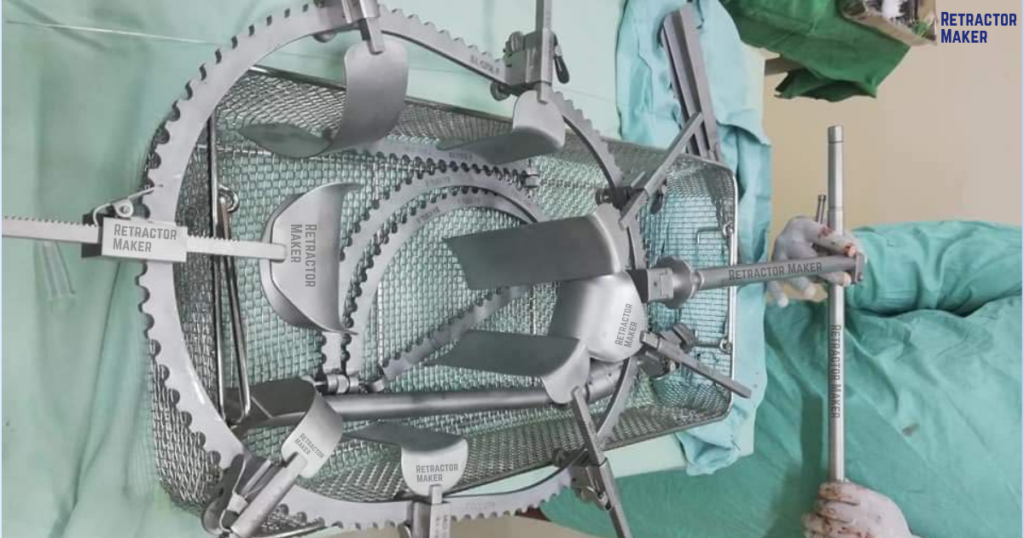
A standard table-mounted Bookwalter Retractor System assembled over the operative field with an oval ring frame and multi-angle tilt ratchets.
The core of the Bookwalter design is its central ring frame (oval or segmented) that sits parallel to the body wall. Notched handle shanks on retractor blades engage spring-loaded slide-on or tilt ratchets clipped around the 360-degree perimeter track, delivering incremental, hands-free tissue traction.
To review complete system specifications, explore the primary Bookwalter Retractor System and browse options in our Bookwalter Retractors Category.
What Is a Thompson Retractor?
A Thompson Retractor is a table-mounted self-retaining retractor system that utilizes an articulated, bilateral frame setup. Unlike single-post ring systems, the Thompson system anchors to both side rails of the operating table using dual rail clamps, building an overhead bridge frame using angled arms and a hinged bilateral crossbar.
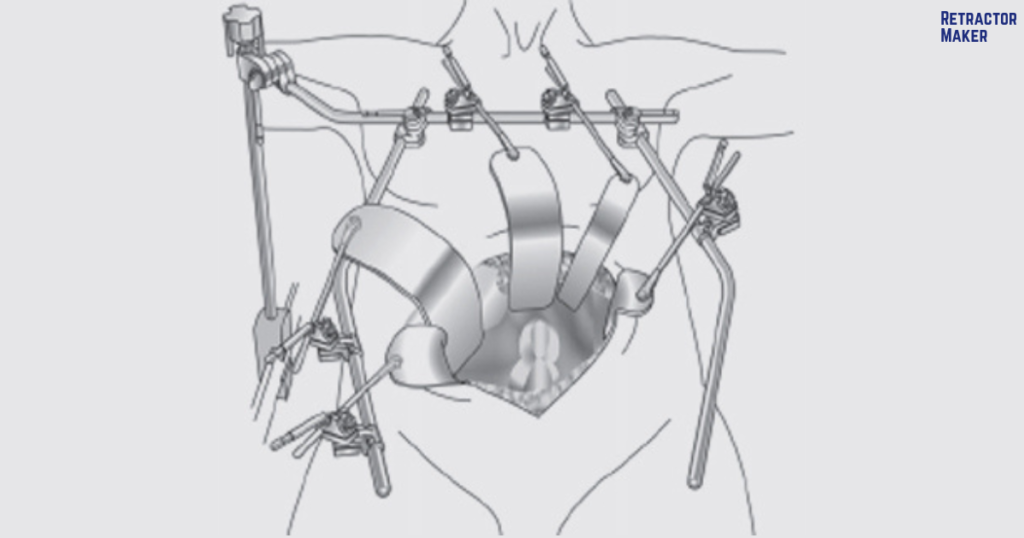
The Thompson Retractor architecture relies on dual rail mounts supporting a bilateral crossbar frame with micro-adjustable handles.
The primary feature of the Thompson platform is its independent multi-planar adjustability. Retractor blades attach to the bilateral crossbar via cam clip-on joints and micro-adjustable screw handles. This allows surgeons to fine-tune blade traction depth and angle independently along individual extension arms.
Brief History of Both Systems
Both retractor platforms emerged in the late 20th century as surgical teams sought to overcome the physical limitations of handheld tools and early fixed abdominal frames.
| System | Invention Era | Primary Design Objective | Structural Paradigm |
| Bookwalter Retractor | Late 1970s (Dr. John R. Bookwalter) | Eliminate assistant fatigue, simplify setup, and provide an unbroken 360-degree perimeter track | Single-post, overhead flex bar, 360-degree ring frame with notched ratchet locks |
| Thompson Retractor | 1980s (Thompson Surgical) | Deliver independent multi-planar arm articulation and micro-adjustable blade tension control | Dual-clamp bilateral crossbar frame with cam joints and screw-driven micro-handles |
- The Bookwalter Origin: Dr. John Bookwalter, an American general surgeon, engineered a simplified ring-and-post framework that could be assembled quickly by a single surgeon. His goal was to provide a standardized, circumferential track matching standard midline laparotomy incisions.
- The Thompson Origin: The Thompson platform was developed to provide independent arm positioning for complex, multi-quadrant surgeries. By utilizing two table mounts and jointed crossbars, it focused on precise, micro-adjustable blade tensioning across non-standard incision angles.
Design Philosophy and Engineering Differences
The fundamental distinction between the Bookwalter and Thompson platforms lies in frame geometry and force distribution across the operating table.
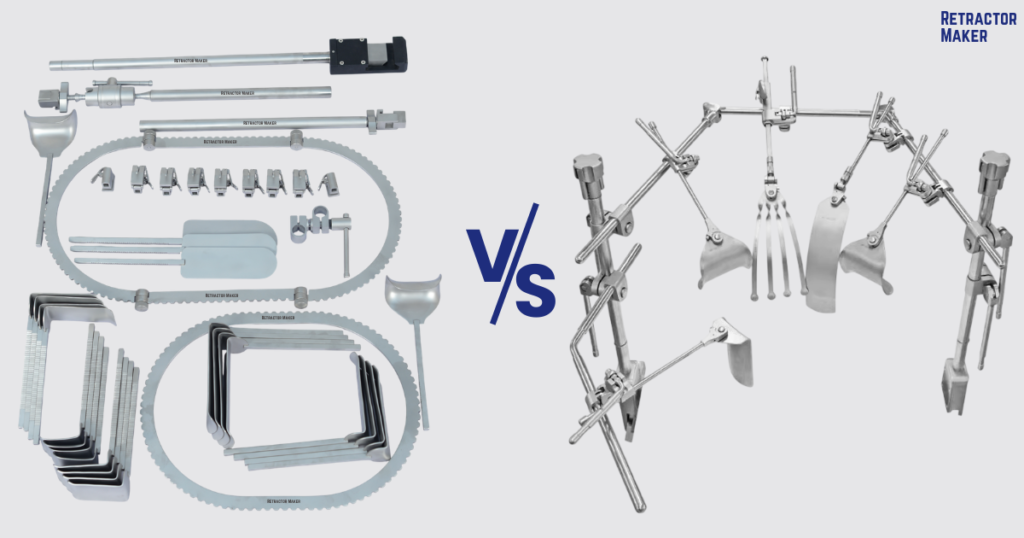
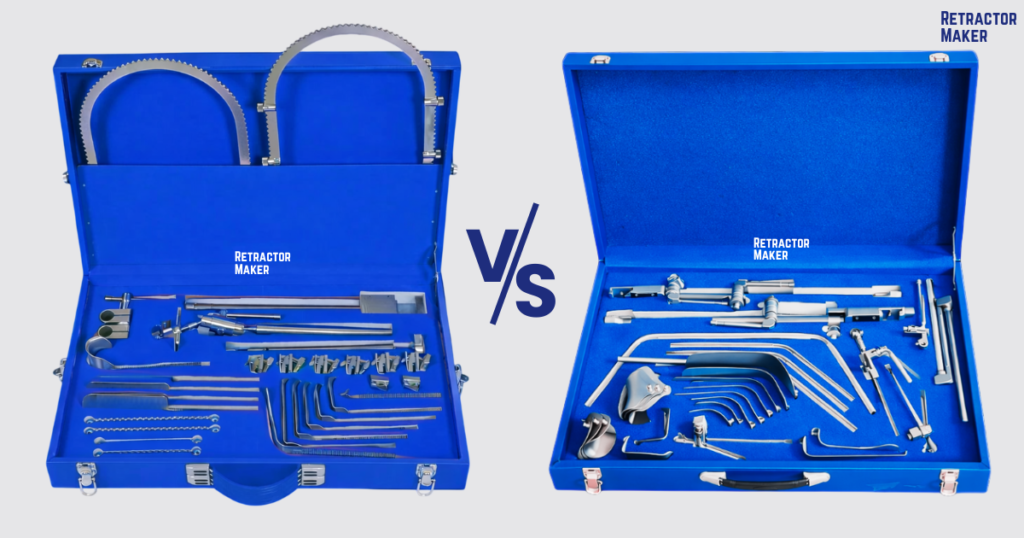
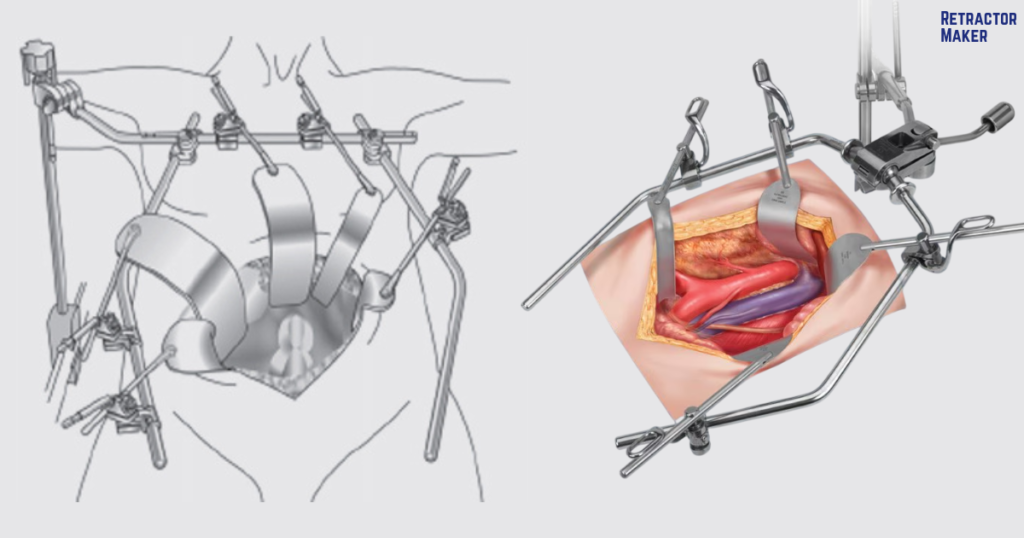
The Bookwalter System (left) utilizes a central circumferential ring frame, while the Thompson System (right) uses a dual-clamp bilateral crossbar bridge frame.
Core Engineering Paradigms:
- Bookwalter Design Philosophy: Closed-Loop Perimeter Architecture. The Bookwalter uses a continuous rigid ring frame (or hinged segmented ring) anchored to a single heavy-duty post coupler. This creates an immovable 360-degree attachment surface surrounding the incision. Ratchets clip anywhere along the ring rim, distributing retraction loads across the closed loop.
- Thompson Design Philosophy: Bilateral Bridge Architecture. The Thompson system constructs a rigid overhead bridge anchored to two table rail clamps. Independent angled arms connect to a hinged bilateral crossbar, allowing surgeons to position individual arms at varying heights and angles around the surgical field.
Components Included in Each System
Comparing the component inventory of standard pre-configured kits highlights the hardware complexity and hardware count of both platforms.
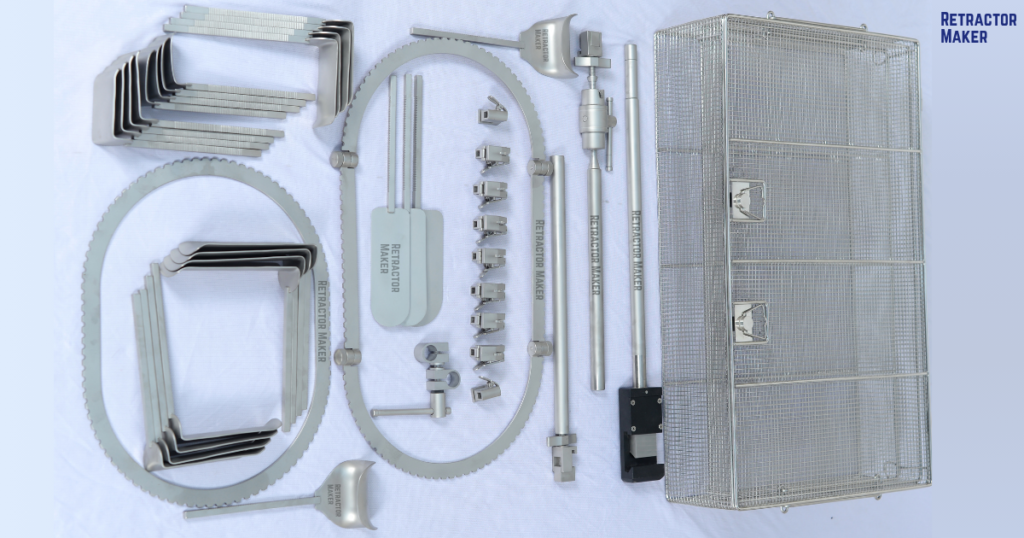
A standard Bookwalter Retractor kit includes 1 field post, 1 coupler, 1 flex bar, 2 ring frames, 9 ratchets, and 21 retractor blades.
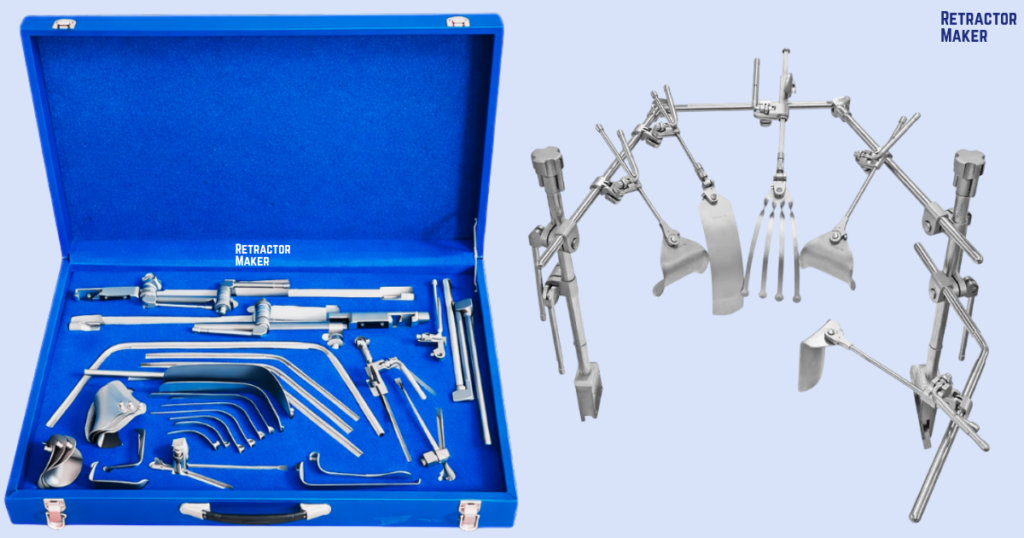
A standard Thompson Retractor kit includes 2 Elite rail clamps, 4 angled arms, 1 hinged crossbar, 3 cam clips, 1 micro-handle, and 17 blades.
System Hardware Specification Comparison
The following table compares the exact hardware specifications included in standard pre-configured kits for both platforms:
| Component Category | Bookwalter Retractor System Specification | Quantity | Thompson Retractor System Specification | Quantity |
| Table Rail Mounting | Heavy-Duty Post Coupler | 1 | Elite Rail Clamp (22″ Heavy-Duty Mount) | 2 |
| Vertical & Frame Arms | Field Post (12″ / 30.5 cm) | 1 | Double Angled Arm (22″) | 1 |
| Horizontal Bar (Standard) | 1 | Lateral Angled Arm (19″ @ 45°) | 1 | |
| Horizontal Flex Bar (1″ / 2.5 cm Dia.) | 1 | Lateral Angled Arms (17″ @ 45°) | 2 | |
| Main Ring / Frame Track | Medium Oval Ring (10½″ × 14½″) | 1 | Bilateral Crossbar (Hinged, 34″) | 1 |
| Medium Segmented Ring (10½″ × 19″) | 1 | — | — | |
| Ratchets & Handles | Standard Ratchets (Non-Tilt) | 2 | Cam Clip-On (Quick-Connect Clips) | 3 |
| Tilt Ratchets (Multi-Angle) | 7 | Micro-Adjustable Handle (10″ Precision) | 1 | |
| Balfour Blades | Balfour Blades (2⅝″ × 3″) | 2 | Balfour Blades with Lips (Various Sizes) | 3 |
| — | — | Wide Balfour Blades (Interchangeable) | 3 | |
| Kelly Blades | Kelly Blades (2″ × 3″) | 4 | Kelly Interchangeable Blades (3″ × 3½″) | 9 |
| Kelly Blades (2″ × 4″) | 4 | — | — | |
| Kelly Blades (2″ × 5″) | 4 | — | — | |
| Kelly Blades (2″ × 6″) | 4 | — | — | |
| Kelly Blades (2″ × 7″) | 4 | — | — | |
| Harrington Blades | — | — | Harrington Blade (4½″ × 10″) | 1 |
| St. Marks Blades | — | — | St. Marks Blades (2″ × 6″) | 2 |
| Malleable Blades | Malleable Blade (3″ × 6″) | 1 | Malleable Blade Set (Multiple Sizes) | 1 Set |
| Malleable Blades (2″ × 6″) | 2 | — | — | |
| Storage Container | Protective Sterilization Organizer Box | 1 | Wooden Storage Case | 1 |
Explore replacement components in our [Bookwalter Parts Page].
Step-by-Step Assembly Comparison
Assembly speed and structural simplicity directly influence surgical team setup efficiency and operating room turnaround times.
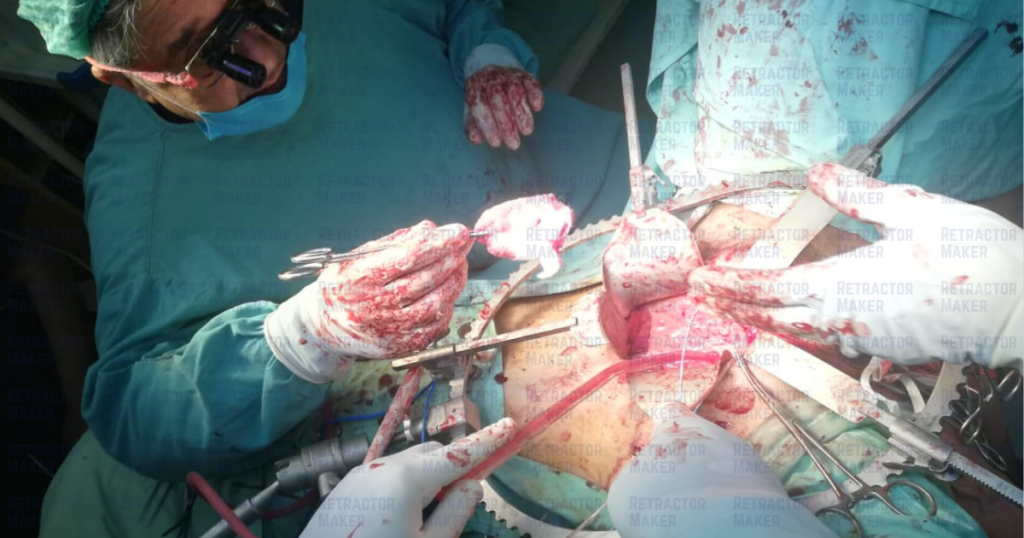
The Bookwalter system mounts to a single table rail clamp, enabling rapid overhead ring leveling and ratchet placement.
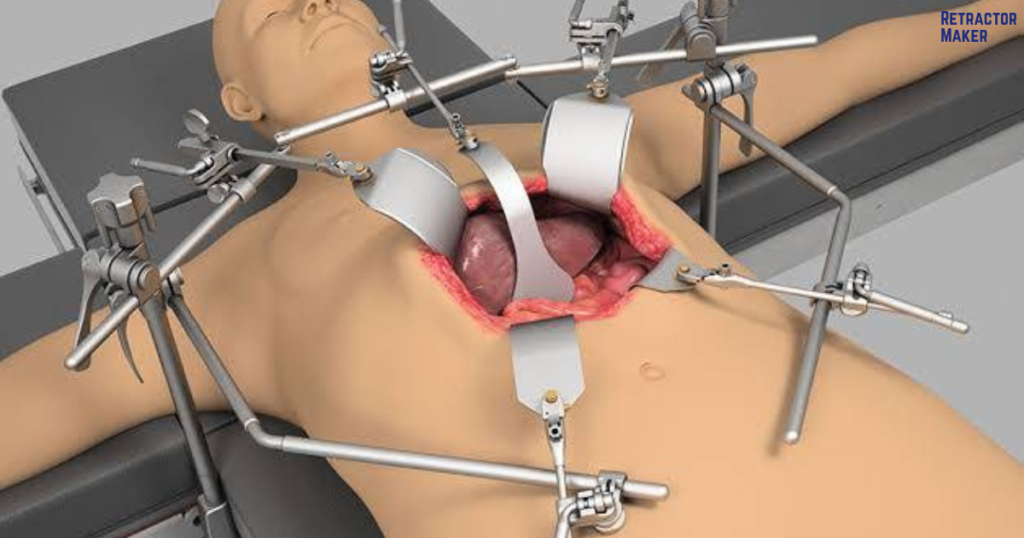
The Thompson system mounts via two heavy-duty rail clamps, building an overhead bilateral crossbar frame over the patient.
Assembly Sequence Comparison:
| Assembly Step | Bookwalter Retractor Workflow | Thompson Retractor Workflow |
| Step 1 | Clamp single post coupler to one table rail over drapes | Clamp two Elite rail clamps to opposite table side rails over drapes |
| Step 2 | Insert 12″ field post into coupler; lock height knob | Insert 22″ double-angled arm and lateral angled arms into clamps |
| Step 3 | Attach horizontal flex bar to field post top | Mount 34″ hinged bilateral crossbar across angled arms |
| Step 4 | Connect central ring frame (Oval or Segmented) | Position cam clip-on connectors along bilateral crossbar arms |
| Step 5 | Snap tilt ratchets onto ring perimeter track | Attach 10″ micro-adjustable handle to target cam clip |
| Step 6 | Insert notched blade shanks into ratchets; pull to lock | Attach interchangeable blade to handle; engage tension screw |
- Bookwalter Setup Time: Requires 2 to 3 minutes. Anchoring to a single rail clamp allows scrub teams to swing the overhead flex bar into position and level the ring frame rapidly.
- Thompson Setup Time: Requires 5 to 8 minutes. Dual rail mounts require alignment on both sides of the table, followed by connecting angled arms and securing the bilateral hinged crossbar.
Blade Compatibility and Engagement Mechanics
How retractor blades connect to the supporting frame determines how quickly surgical teams can adjust tissue tension during surgery.
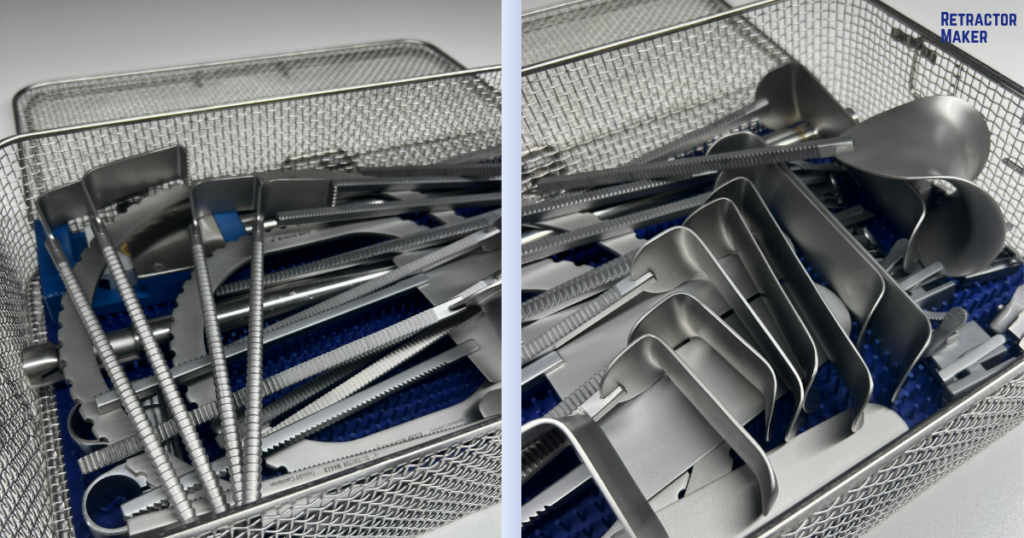
Bookwalter blades feature notched handle shanks that slide into ratchet channels and lock via spring-loaded pawls.
Thompson blades connect to micro-adjustable handles or cam clips using keyhole slot adapters.
| Metric / Feature | Bookwalter Notched Shank Mechanism | Thompson Micro-Adjustable Mechanism |
| Shank Style | Flat handle shank with machined edge notches | Keyhole shank or cylindrical adapter pin |
| Locking Mechanism | Spring-loaded ratchet pawl drops into notches | Screw-driven micro-handle or cam lever clip |
| Tension Control | Manual pull-to-tension; instant notch engagement | Screw-turn precision handle for fine millimeter adjustment |
| Release Speed | Instant single-thumb lever release | Requires un-threading micro-handle screw |
Find additional blade options in our [Bookwalter Blades Page].
Frame and Support Structure Comparison
The structural design of the frame dictates how much overhead working space is available to the surgical team.
- Bookwalter Framework: Suspends a continuous loop (Oval or Hinged Segmented ring) directly over the incision. The 360-degree ring track allows ratchets to clip anywhere around the perimeter, maintaining an open overhead corridor for surgical lighting and primary instruments.
- Thompson Framework: Constructs an overhead bridge using a 34″ hinged bilateral crossbar supported by lateral angled arms (17″ and 19″ @ 45°). While providing strong multi-directional arm placement, the overhead crossbars create a larger frame footprint above the patient.
Ratchet and Micro-Adjustment Mechanisms
Both systems utilize distinct mechanical principles to apply and maintain tissue tension:
- Bookwalter Ratchet Mechanics: Utilizes Standard Ratchets and Multi-Angle Tilt Ratchets. Tilt ratchets feature an internal gear hinge that allows surgeons to tilt attached retractor blades upward or downward at variable pitch angles, adding vertical tissue lift to lateral traction.
- Thompson Handle Mechanics: Utilizes Micro-Adjustable Precision Handles (10″) paired with Cam Clips. The micro-adjustable handle features a threaded lead screw that allows surgeons to fine-tune blade retraction force in precise millimeter increments by turning a handle knob.
Stability and Surgical Exposure Under Force
In procedures requiring heavy tissue retraction—such as bariatric laparotomies or deep pelvic dissections—frame stability under lateral load is paramount.
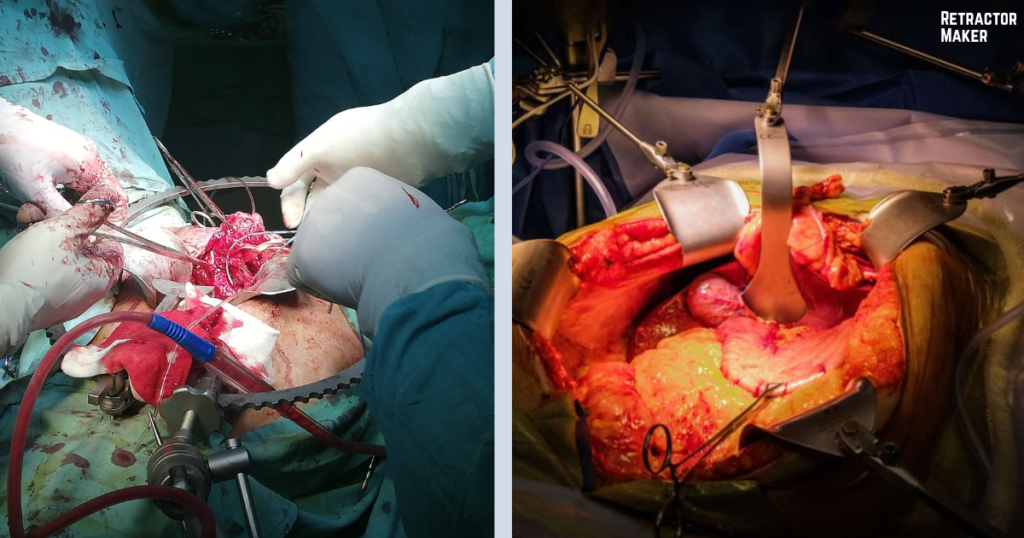
The Bookwalter system (left) distributes lateral stress across a closed ring, while the Thompson system (right) relies on dual rail mounts and crossbar joints.
- Bookwalter Stability: The closed-loop oval or segmented ring frame distributes retraction force evenly around its entire perimeter. When heavy lateral pressure is applied to one blade, the opposing side of the ring absorbs part of the mechanical stress, preventing frame twisting.
- Thompson Stability: Dual Elite rail clamps mounted to opposite side rails provide an immovable foundation. The rigid bilateral crossbar resists bowing, though multi-jointed arm connections must be fully torqued to prevent joint slip under extreme lateral force.
Ease of Setup and Intraoperative Repositioning
During extended operations, surgeons frequently need to adjust retractor blade positions or shift retraction angles:
- Bookwalter Repositioning: To move a blade, the surgeon depresses the ratchet thumb lever, slides the ratchet to a new location on the ring, and pulls the blade shank to re-lock. Repositioning takes 5 to 10 seconds per blade.
- Thompson Repositioning: To reposition a blade, the surgeon un-threads the micro-adjustable handle screw, releases the cam clip-on connector, moves the clip along the crossbar, re-engages the handle, and turns the screw to re-tension. Repositioning takes 20 to 40 seconds per blade.
Surgical Specialties and Clinical Applications
Both platforms perform exceptionally across open surgical specialties, with specific design features favoring particular procedural approaches.
| Surgical Specialty | Bookwalter Performance | Thompson Performance | Primary Clinical Consideration |
| General Surgery (Laparotomy) | Superior | Excellent | Oval ring matches longitudinal midline incisions perfectly |
| Bariatric Surgery | Superior | Good | Heavy-duty single post resists flex under thick abdominal wall loads |
| Deep Pelvic (Gynecology/Colorectal) | Superior | Superior | Segmented ring + tilt ratchets vs. Thompson St. Marks deep blades |
| Open Urology (Nephrectomy/Transplant) | Excellent | Superior | Thompson bilateral crossbars excel in wide flank/subcostal access |
| Open Vascular (AAA Repair) | Superior | Excellent | Bookwalter non-slip ratchet hold maintains aortic exposure |
| Spine & Orthopedic Access | Good | Superior | Thompson micro-adjustable handles allow precise millimeter spread |
Cleaning, Sterilization, and Maintenance Protocols
Central Sterile Processing Departments (CSPD) handle instrument reprocessing daily. Equipment complexity directly affects cleaning efficiency, storage footprint, and tray organization.
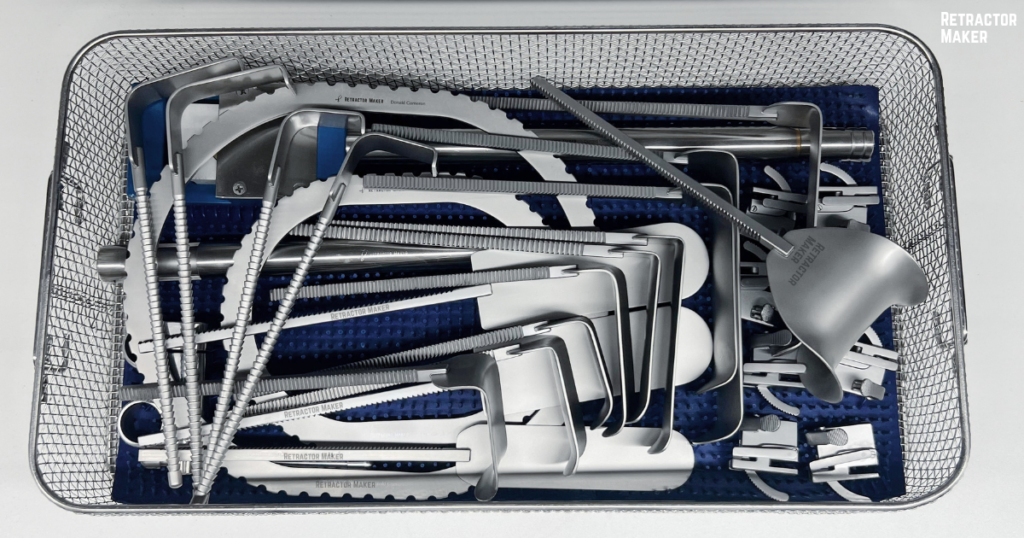
Bookwalter components feature open ratchet channels and smooth surfaces that organize cleanly inside perforated sterilization trays.
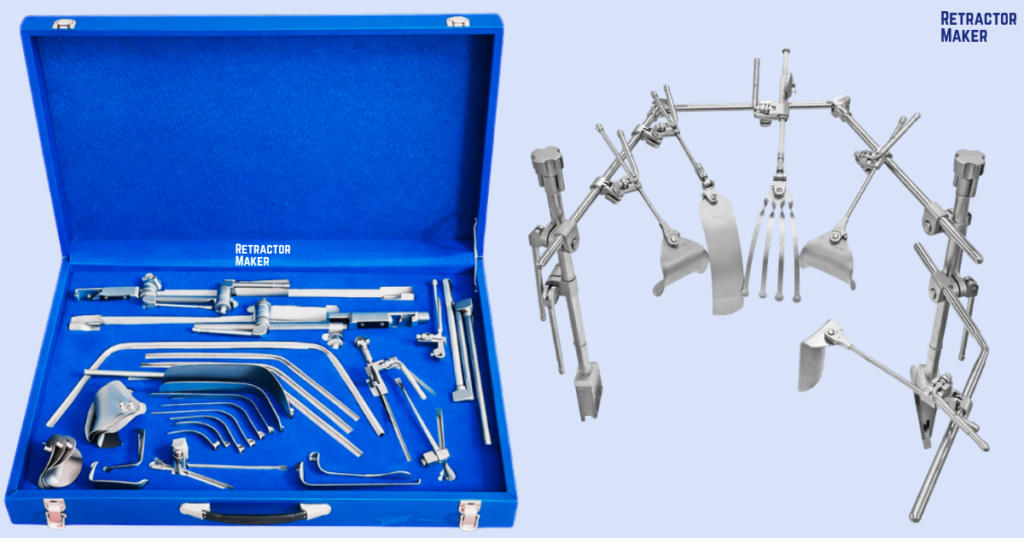
Thompson Retractor sets utilize wooden storage cases or specialized stainless steel trays for padded component protection.
Reprocessing Comparison:
- Bookwalter Reprocessing: Components disassemble into major structural units (coupler, post, flex bar, ring, individual ratchets, and blades). Ratchets feature open spring channels that flush easily during automated washing. Perforated trays keep hardware sorted for pre-vacuum steam sterilization (134°C / 273°F for 4 to 5 minutes).
- Thompson Reprocessing: Requires disassembling threaded micro-adjustable handles, cam clip joints, and multi-piece angled arms. CSPD technicians must scrub internal screw threads on precision handles thoroughly to prevent enzymatic cleaner or tissue residue buildup.
Complete Side-by-Side Comparison Tables
The following tables synthesize the key structural, operational, and clinical differences between the Bookwalter and Thompson retractor platforms based on the component lists provided.
1. Architectural & Specification Comparison
| Feature / Metric | Bookwalter Retractor System | Thompson Retractor System |
| Mounting Architecture | Single Heavy-Duty Post Coupler | Dual Elite Rail Clamps (22″ Heavy-Duty) |
| Vertical & Overhead Support | Field Post (12″) + Flex Bar (1″ Dia.) | Double Angled Arm (22″) + Lateral Arms (17″/19″) |
| Primary Frame Track | Medium Oval & Segmented Rings | 34″ Bilateral Crossbar (Hinged) |
| Tension / Ratchet Mechanism | 2 Standard + 7 Multi-Angle Tilt Ratchets | 3 Cam Clips + 1 Micro-Adjustable Precision Handle |
| Blade Attachment Style | Flat notched handle shanks (Automatic pawl) | Keyhole shank / adapters (Micro-screw engagement) |
| Total Kit Blade Count | 21 Retractor Blades (Balfour, Kelly, Malleable) | 17 Retractor Blades (Balfour, Kelly, Harrington, St. Marks, Malleable) |
| Storage & Container | Protective Sterilization Organizer Box | Wooden Storage Case with padding slots |
| Average Setup Time | 2 to 3 minutes | 5 to 8 minutes |
2. Clinical & Operational Performance Factors
| Operational Metric | Bookwalter Retractor System | Thompson Retractor System |
| Heavy Tissue Load Stability | High (Closed ring distributes lateral force) | High (Dual rail clamps anchor bilateral frame) |
| Micro-Tension Control | Incremental (Notch-by-notch ratchet advance) | Continuous Millimeter (Threaded micro-screw handle) |
| Deep Pelvic Exposure | Superior (Tilt ratchets + deep Kelly/Malleable blades) | Superior (St. Marks blades + micro-handle pitch) |
| Midline Laparotomy Efficiency | Superior (Oval ring surrounds longitudinal wound) | Excellent (Bilateral crossbar bridges incision) |
| Intraoperative Repositioning | Rapid (5–10 seconds per ratchet move) | Moderate (20–40 seconds per micro-handle shift) |
| CSPD Cleaning Simplicity | High (Open ratchet channels, fewer screw threads) | Moderate (Multiple internal threaded handles & cam joints) |
| Replacement Parts Availability | Widespread universal industry compatibility | Proprietary manufacturer-specific fit |
Which System Is Better for Your Facility?
Neither platform is universally superior; rather, each excels according to specific surgical preferences, clinical case mixes, and operational priorities.
Choose the Bookwalter Retractor System If:
- Your facility performs high volumes of general surgery, open laparotomies, bariatric procedures, deep pelvic operations, and open vascular repairs.
- Your operating room staff prioritizes rapid 2-to-3-minute assembly, intuitive ratchet pull-locking, and 360-degree perimeter access.
- Your procurement team wants a durable, modular system with widely available, cost-effective replacement parts and blades.
- Your Central Sterile Processing Department prefers streamlined reprocessing with perforated trays and fewer small threaded parts.
Choose the Thompson Retractor System If:
- Your surgical department performs a high volume of complex multi-quadrant open procedures, anterior lumbar spine access, or specialized urological flank approaches.
- Your surgeons demand continuous, millimeter-precise micro-adjustable screw tensioning for delicate tissue retraction.
- Your surgical team prefers bilateral bridge framing anchored to two operating table side rails.
Explore Our Complete Corporate Network
As a specialized global manufacturer of self-retaining surgical retractor systems, our corporate manufacturing network serves healthcare facilities, surgical centers, and medical distributors across multiple specialized surgical domains:
- Retractor Maker — Explore our complete corporate catalog of self-retaining retractor systems, specialized table-mounted systems, and custom OEM manufacturing capabilities across all surgical disciplines.
- Leyla Retractor — Discover our dedicated product line of specialized Leyla neurosurgical retractor systems, flexible holding arms, cranial fixation clamps, and neurosurgical accessories.
Frequently Asked Questions (FAQs)
What is the primary structural difference between a Bookwalter and a Thompson retractor?
The Bookwalter system utilizes a single post coupler supporting a central 360-degree ring frame (oval or segmented). The Thompson system uses dual rail clamps supporting an overhead bilateral crossbar frame with angled arms.
Are Bookwalter and Thompson retractor blades interchangeable?
No. Standard Bookwalter blades feature flat handle shanks with edge notches designed for spring-loaded ratchets. Thompson blades utilize keyhole shanks or pin adapters designed for micro-adjustable handles and cam clip-on joints.
Which retractor system is faster to assemble in the operating room?
The Bookwalter Retractor is faster to assemble (typically 2 to 3 minutes) because it mounts via a single post coupler and overhead flex bar, whereas the Thompson system requires mounting two rail clamps and assembling a multi-piece bilateral crossbar frame (5 to 8 minutes).
What is the advantage of Thompson’s micro-adjustable handle?
The micro-adjustable handle uses a threaded screw mechanism that allows surgeons to adjust blade retraction force in precise millimeter increments, which is particularly useful during delicate tissue spread in spine or retroperitoneal surgery.
What is the advantage of Bookwalter’s tilt ratchets?
Tilt ratchets feature an internal gear mechanism that allows surgeons to tilt retractor blade tips upward or downward, delivering vertical tissue lift and deep pelvic exposure while the ring frame remains parallel to the patient’s torso.
Which system is better for bariatric surgery?
The Bookwalter Retractor is widely preferred for bariatric operations. Its heavy-duty 12″ field post and closed-loop ring frame resist deflection under heavy lateral tissue loads, accommodating deep Kelly blades up to 2″ × 7″.
Can I buy individual replacement parts for a Bookwalter Retractor System?
Yes. Healthcare facilities can purchase standalone replacement hardware—such as field posts, post couplers, flex bars, tilt ratchets, and individual Kelly or Balfour blades—from specialized manufacturers like Retractor Maker to maintain existing hospital trays.
How do CSPD reprocessing protocols compare between both systems?
Bookwalter components feature open ratchet channels and fewer threaded fasteners, allowing straightforward enzymatic washing and steam sterilization in perforated trays. Thompson sets include threaded micro-adjustable handles and cam clips that require meticulous thread scrubbing.
How many blades are included in standard Bookwalter vs. Thompson kits?
In the standard pre-configured kits detailed above, the Bookwalter set includes 21 retractor blades (featuring 20 Kelly blades ranging from 2″ × 3″ to 2″ × 7″, 2 Balfour blades, and 3 Malleable blades). The Thompson set includes 17 retractor blades (including Balfour, Kelly, Harrington, St. Marks, and Malleable blades).
Which retractor system is more cost-effective for hospitals?
Bookwalter systems are generally more cost-effective over their operating lifespan due to standardized component dimensions, rapid OR assembly times, simple modular maintenance, and widely available replacement hardware.
Conclusion
Both the Bookwalter Retractor System and the Thompson Retractor System represent proven, medical-grade engineering solutions for open surgical exposure. Selecting the optimal platform depends on your facility’s primary surgical case mix, surgical preferences, and operating room workflow priorities.
For hospitals, surgical centers, and procurement teams seeking rigid 360-degree stability, rapid 2-to-3-minute setup, and cost-effective component maintenance across general, bariatric, gynecological, and vascular operations, the Bookwalter Retractor System remains an industry benchmark.
To explore complete system setups, specialized retractor blades, or standalone replacement hardware, view our full catalog in the Bookwalter Retractors Category or review the primary Bookwalter Retractor System. You can also examine our corporate catalog at Retractor Maker and specialized neurosurgical solutions at Leyla Retractor.
Request Your B2B Quotation
Retractor Maker is a specialized manufacturer supplying factory-direct table-mounted retractor systems, replacement components, and surgical accessories to hospitals, surgical centers, medical distributors, and procurement teams worldwide.
Contact Us — Speak directly with our manufacturing specialists regarding bulk orders or OEM requests.
Request a Quote Now — Receive formal B2B pricing and fulfillment timelines.
Download Product Catalogue — Access complete technical specifications and part lists.