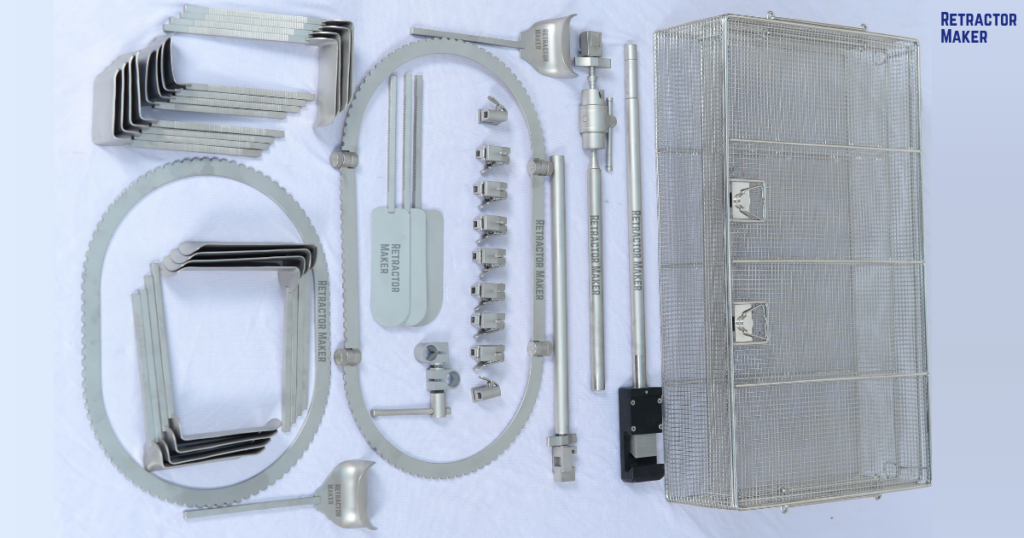
Bookwalter Retractor vs Omni Retractor: Complete Surgical System Comparison

Selecting the ideal table-mounted self-retaining retractor system is a key decision for hospital surgical departments, central sterile processing personnel, and healthcare procurement teams. The Bookwalter Retractor System and the Omni Retractor System represent the two leading design paradigms in modern open surgical retraction. While both systems mount directly to operating table side rails to provide hands-free tissue tension, they differ in structural architecture, frame geometry, blade attachment mechanics, and clinical workflows. This comprehensive, unbiased guide compares the history, hardware components, assembly steps, specialty applications, and purchasing considerations for both retractor platforms.
Introduction
In major open abdominal, pelvic, urological, and vascular operations, maintaining clear visual exposure is fundamental to surgical success. Manual retraction—relying on scrub staff or surgical residents to hold handheld steel blades for hours—introduces muscle fatigue, subtle instrument movement, uneven tissue tension, and physical crowding around the incision line.
Table-mounted self-retaining retractor systems solve these problems by anchoring the physical load of tissue retraction directly to the heavy steel frame of the operating table. The two most widely adopted platforms in healthcare facilities globally are the Bookwalter Retractor System and the Omni Retractor System.
While both platforms achieve the shared clinical goal of stable, hands-free retraction, they utilize distinct engineering approaches:
- The Bookwalter System relies on a robust, single-post vertical column supporting a circumferential perimeter ring frame (oval or segmented) and quick-clip notched ratchets.
- The Omni System utilizes a dual-post or wishbone frame architecture featuring jointed articulated arms and screw-clamp or snap-lock blade holders.
Understanding the practical differences between these two platforms enables hospital procurement boards, OR managers, and surgical directors to choose the system that best matches their clinical procedure mix and operational preferences.
What Is a Bookwalter Retractor?
A Bookwalter Retractor is a modular, table-mounted, self-retaining retractor system designed to secure open operative fields during major surgery. Invented in the late 1970s by Dr. John R. Bookwalter, the platform clamps to an operating table side rail via a heavy-duty post coupler, extending a vertical field post and an articulated horizontal flex bar over the patient.
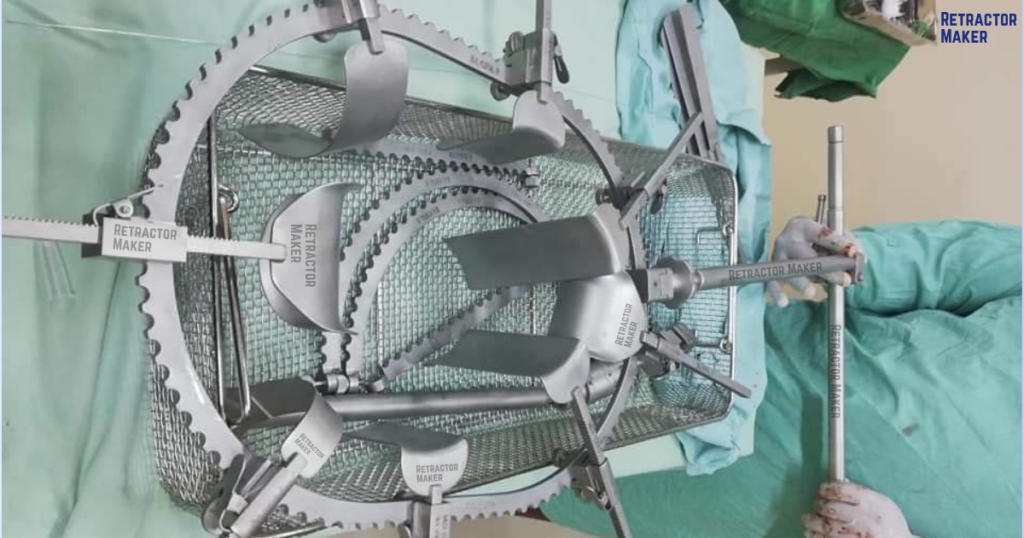
The core of the Bookwalter design is its central ring frame (available in medium oval, large oval, extra-large oval, round, or hinged segmented geometries) that hangs parallel to the body wall. Notched retractor blades engage spring-loaded slide-on or tilt ratchets attached around the 360-degree ring track, providing static, incremental tissue traction.
To review full specifications, explore the primary Bookwalter Retractor System and browse options in our Bookwalter Retractors Category.
What Is an Omni Retractor?
An Omni Retractor (commonly referred to as an Omni-Tract style system) is a table-mounted self-retaining surgical retractor that utilizes an articulated wishbone frame or flexible multi-jointed arm setup. Rather than placing a single continuous ring over the patient, the Omni platform relies on two main side arms attached to table posts, creating a semi-rigid frame surrounding the incision.
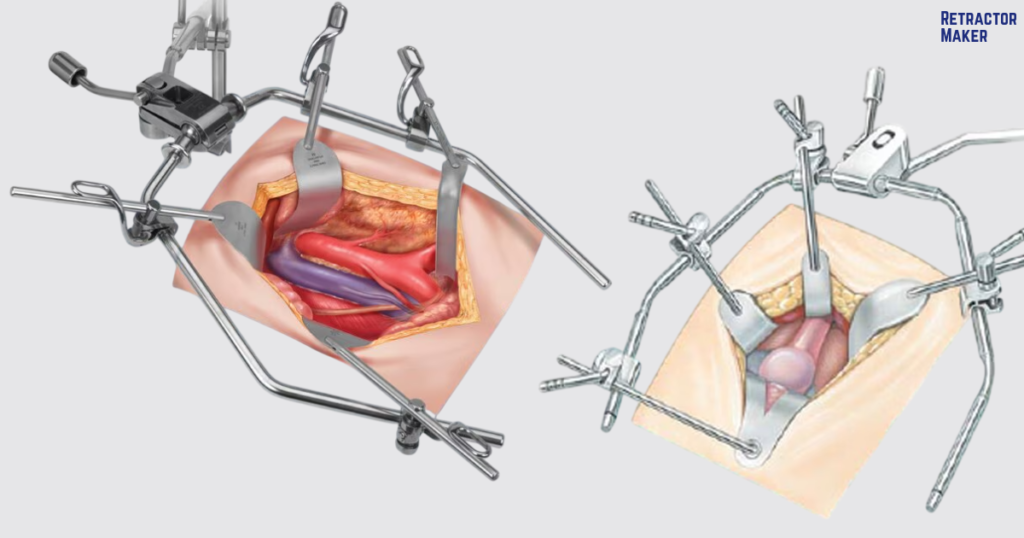
The Omni Retractor architectural framework relies on articulated wishbone arms and multi-jointed structural links.
The primary characteristic of the Omni system is its articulation. Its jointed arms allow surgical teams to shape the retraction frame around irregular body contours or configure narrow operative corridors for lateral and subcostal approaches. Retractor blades attach to the wishbone frame using specialized mechanical blade holders that lock via thumb-screws or quick-release levers.
Brief History of Both Systems
Both systems were developed during the mid-to-late 20th century to address the limitations of handheld retractors and early fixed abdominal spreaders.
| Era / Milestone | System Development Event | Primary Objective |
| Late 1970s | Dr. John R. Bookwalter patents the post-and-ring retractor system | Simplify setup, provide 360-degree perimeter access, and eliminate assistant muscle fatigue |
| 1980s | Omni-Tract surgical systems develop the articulated wishbone frame | Create highly adjustable, jointed arms for localized and non-standard incision access |
| 1990s–Present | Both platforms establish widespread international adoption | Standardize surgical stainless steel alloys, introduce tilt ratchets, and optimize CSPD tray designs |
- The Bookwalter Origin: Dr. John Bookwalter, an American general surgeon, engineered a simplified ring-and-post architecture that could be assembled quickly by a single surgeon. His goal was to provide a standardized 360-degree track that fit standard midline laparotomy incisions while holding tissue margins steadily.
- The Omni Origin: The Omni platform evolved from the need for localized, highly adjustable retraction arms that could conform around non-standard surgical approaches. By incorporating multiple swivel joints along wishbone-style arms, the Omni system focused on anatomical adaptation in specialized procedures.
Design Philosophy and Structural Differences
The fundamental difference between the Bookwalter and Omni platforms lies in how their structural frames encircle the surgical site.
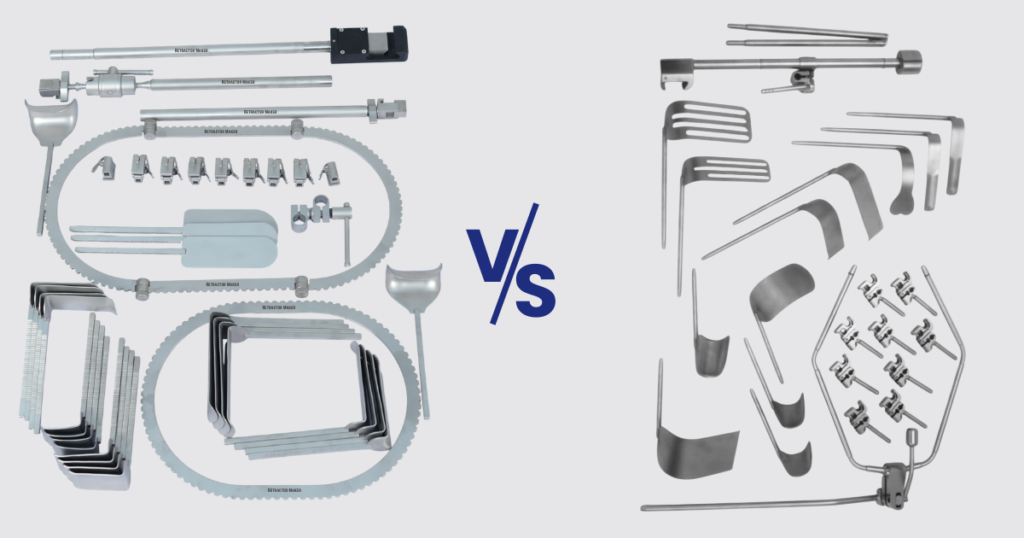
Structural Comparison Breakdown:
- Bookwalter Design Philosophy: Rigid Perimeter Geometry. The system uses a continuous, rigid ring frame anchored to a single heavy-duty table post. This creates an immovable 360-degree track suspended above the patient. Ratchets can be clipped anywhere along the ring perimeter, offering multi-vector traction inward toward the center of the ring.
- Omni Design Philosophy: Articulated Link Flexibility. The Omni system uses jointed wishbone arms that can be bent, angled, or spread wide apart using multi-angle locking joints. This allows surgeons to shape the frame directly along the contours of the patient’s torso, particularly in non-planar or unilateral surgical approaches.
Components Included in Each System
Comparing the component inventory of standard system kits illustrates the mechanical complexity and hardware count of each platform.
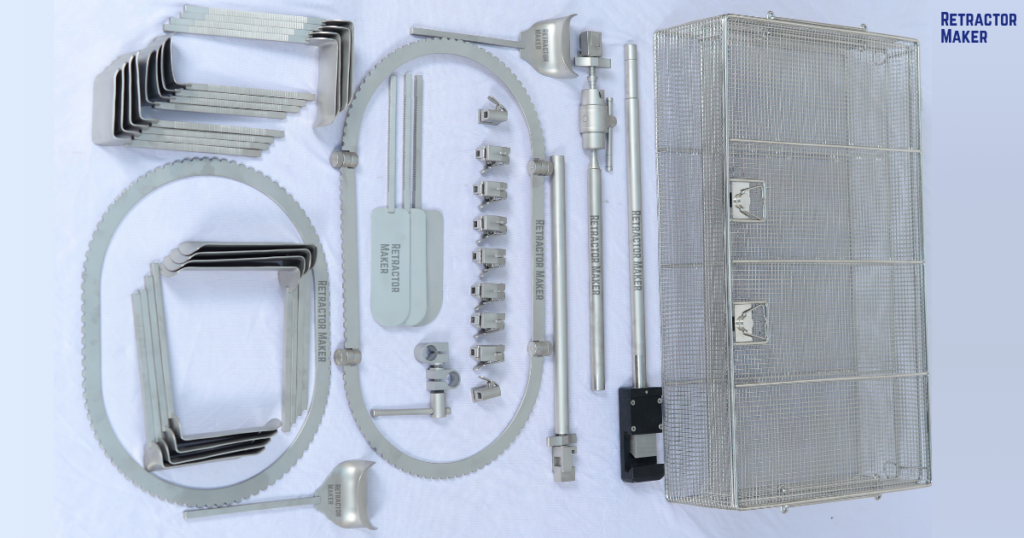
A standard Bookwalter kit includes a post coupler, field post, flex bar, oval/segmented rings, tilt ratchets, and notched blades.
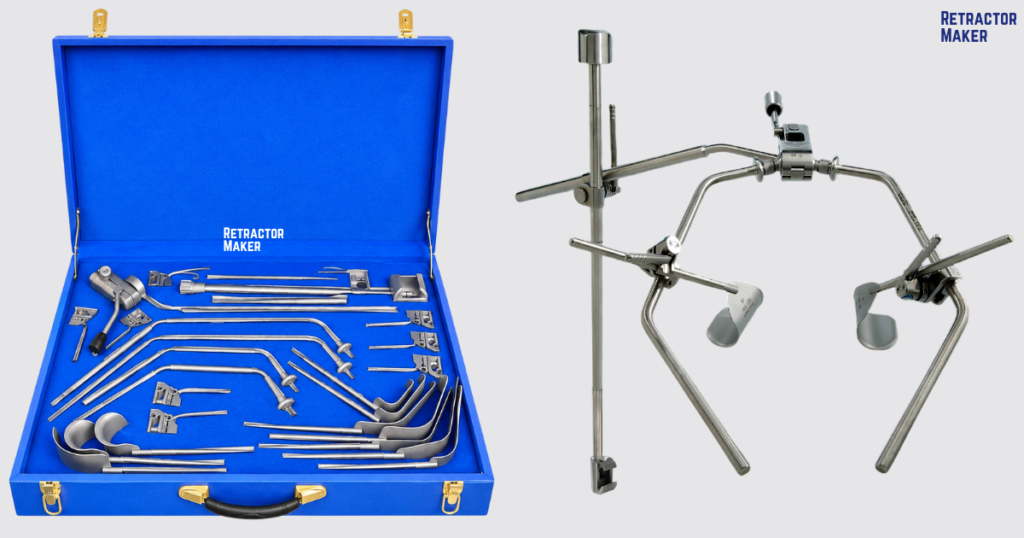
An Omni Retractor kit includes dual table mounting posts, articulated wishbone arms, joint links, and screw-locking blade holders.
| Component Category | Standard Bookwalter System Kit | Standard Omni System Kit |
| Table Mounting | 1 Heavy-Duty Post Coupler (Rail Clamp) | 2 Table Mounting Clamps |
| Vertical Support | 1 Vertical Field Post (12″) | 2 Vertical Support Posts |
| Extension Framework | 1 Horizontal Flex Bar (Articulated Ball Joint) | 1 Wishbone Arm Assembly (Jointed) |
| Primary Frame Track | 1 Medium Oval Ring & 1 Medium Segmented Ring | 2 Articulated Extension Links |
| Ratchets & Holders | 2 Standard Slide-On & 7 Tilt Quick-Clip Ratchets | 6–8 Screw-Lock or Snap Blade Holders |
| Retractor Blades | Assorted Blades with Notched Handle Shanks | Assorted Blades with Pin-Shank Adapters |
| Storage & Reprocessing | Perforated Stainless Steel Sterilization Container | Perforated Stainless Steel Sterilization Container |
Inspect standalone mounting accessories and hardware in our [Bookwalter Parts Page].
Assembly and Setup Comparison
Assembly speed and mechanical simplicity directly impact operating room turnaround times and sterile field setup efficiency.
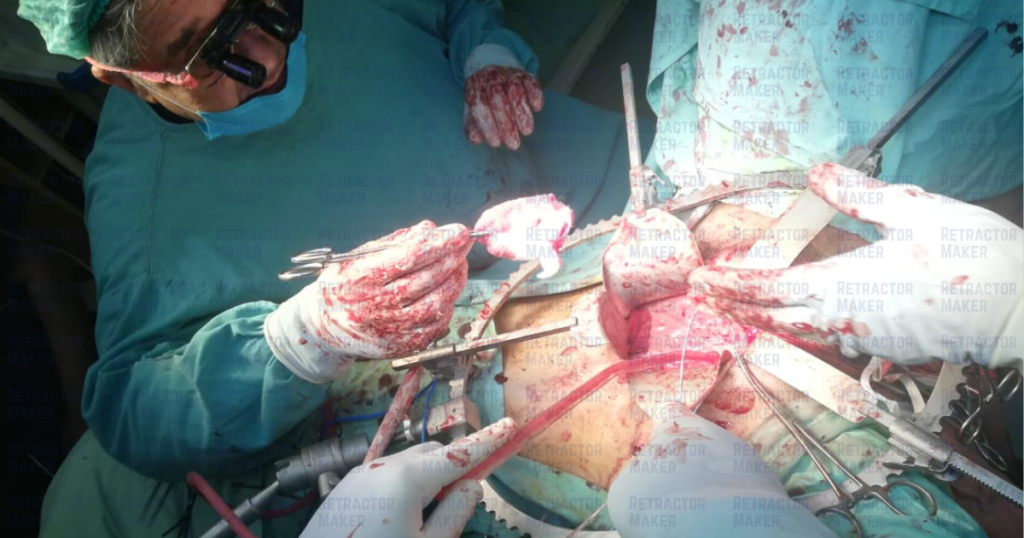
The Bookwalter system mounts to a single table rail clamp, allowing rapid overhead ring positioning.
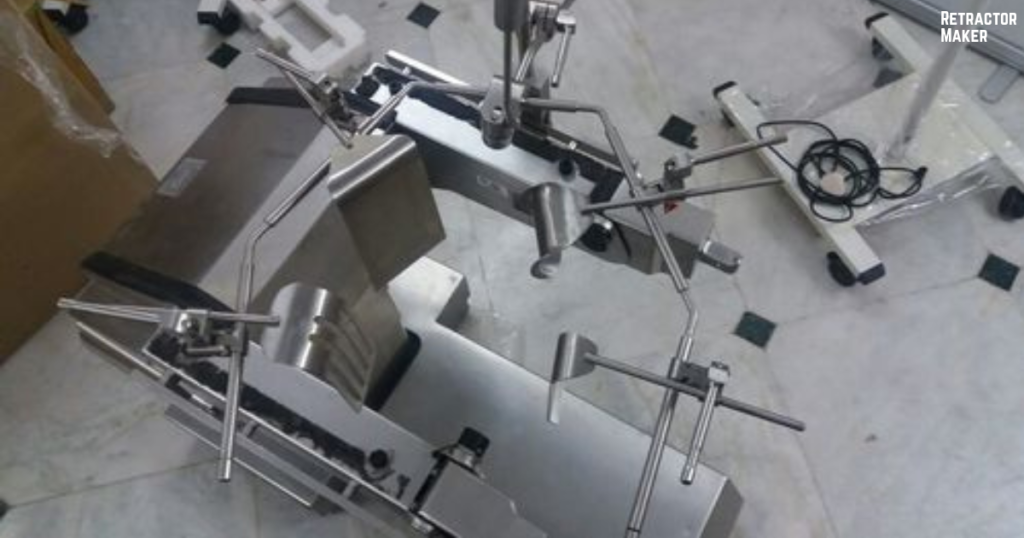
The Omni Retractor mounts using two table side clamps to anchor its articulated wishbone framework.
| Step | Bookwalter Assembly Sequence | Omni Assembly Sequence |
| 1 | Clamp single post coupler to table rail over drapes | Clamp primary table post to side rail over drapes |
| 2 | Insert vertical field post into post coupler block | Clamp secondary table post to opposite side rail |
| 3 | Attach horizontal flex bar to vertical post top | Mount wishbone arm frames to both table posts |
| 4 | Connect central ring frame (Oval or Segmented) | Adjust multiple joint levers to shape the frame |
| 5 | Snap tilt ratchets onto ring perimeter track | Attach blade holders onto wishbone arm track |
| 6 | Insert notched blade shanks into ratchet channels | Secure pin-shank blades using knurled thumb screws |
- Bookwalter Assembly Workflow: Relies on a single post coupler clamped to one side rail. The overhead flex bar suspends the ring directly over the incision. Scrub teams typically complete full assembly in 2 to 3 minutes.
- Omni Assembly Workflow: Often requires attaching mounting clamps to both side rails of the operating table to stabilize the wishbone frame. The scrub team must adjust multiple articulation joints and tighten individual clamp links, typically taking 4 to 6 minutes.
Blade Compatibility and Attachment Mechanics
The mechanism used to connect retractor blades to the supporting framework determines how easily surgical teams can adjust tissue retraction mid-operation.
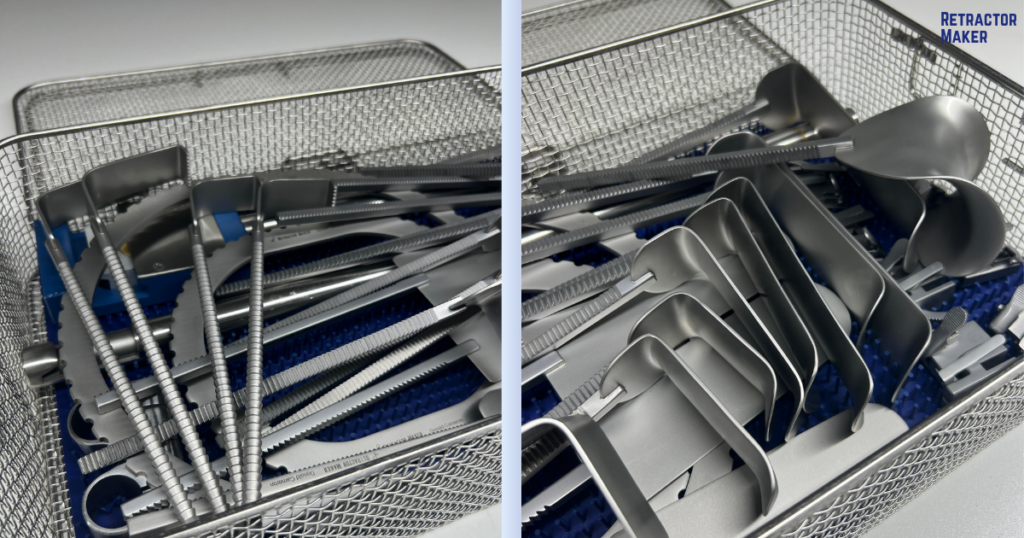
Bookwalter blades feature notched handle shanks that slide into ratchet channels and lock via spring pawls.
| Metric / Feature | Bookwalter Notched Shank Mechanism | Omni Pin & Screw Mechanism |
| Shank Architecture | Flat handle shank with machined teeth | Cylindrical pin shank or sliding adapter |
| Locking Type | Automatic spring-loaded pawl engagement | Manual knurled thumb-screw or clamp lever |
| Adjustment Speed | Instant pull-to-tension; single thumb lever release | Requires un-threading screw, manual shift, and re-tightening |
| Angle / Tilt Control | Integrated tilt gear in ratchet for vertical lift | Articulated arm joints adjust overall frame pitch |
Blade Engagement Mechanics:
- Bookwalter Notched Shank Mechanism: Standard Bookwalter blades feature a flat handle shank with evenly spaced notches machined along its edge. The shank slides into a spring-loaded ratchet channel. The surgeon pulls the blade outward, and the ratchet pawl drops automatically into a notch, locking the tissue under static tension. Releasing requires pressing a single thumb lever. Explore replacement blades in our [Bookwalter Blades Page].
- Omni Pin & Screw Mechanism: Omni blades frequently utilize a cylindrical pin shank or specialized sliding adapter shank. The shank slides into a blade holder mounted on the wishbone arm and is tightened manually using a knurled thumb screw or lever clamp. Adjusting blade depth requires loosening the screw, manually repositioning the blade, and re-tightening the screw.
Ring and Frame Geometry Comparison
The geometry of the supporting frame determines the working space available to the surgical team and overhead operating lights.
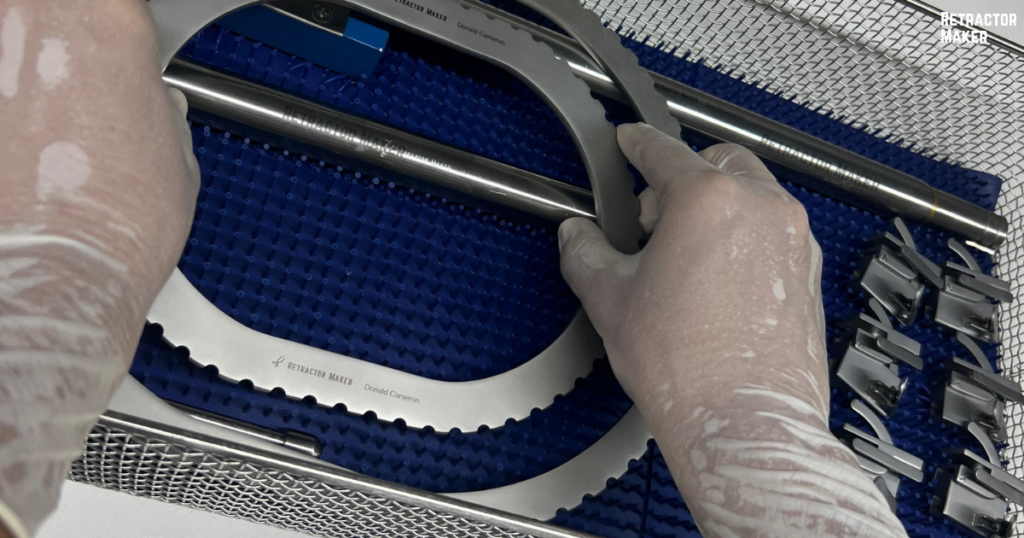
Bookwalter oval rings provide a rigid, unbroken 360-degree perimeter track around abdominal incisions.
- Bookwalter Frame Geometry: Utilizes continuous rigid loops (Oval, Round, or Hinged Segmented). The oval ring matches standard midline laparotomy incisions, providing an unbroken 360-degree attachment surface around the wound perimeter.
- Omni Frame Geometry: Utilizes an open-ended wishbone configuration formed by jointed arms. This structure can be expanded or contracted in width, making it adaptable to wide transverse or asymmetrical incisions where an oval ring might press against patient tissue.
Retraction Flexibility and Multi-Vector Control
Controlling retraction vectors allows surgical teams to lift tissue upward while pulling laterally, exposing deep anatomical planes.
- Bookwalter Vector Control: Uses Tilt Ratchets and Rotating Tilt Ratchets. While the ring frame sits parallel to the body wall, individual tilt ratchets permit the retractor blade to tilt upward or downward at variable pitch angles. This allows simultaneous lateral traction and vertical lift (e.g., under subcostal margins or deep pelvic fascia).
- Omni Vector Control: Uses Articulated Joint Links. Because the wishbone frame arms themselves contain multi-angle joints, the surgical team can tilt individual sections of the frame upward or downward, altering the vector of attached blade holders directly.
Stability and Tissue Holding Capacity During Surgery
In procedures requiring significant physical force—such as retracting heavy abdominal walls in bariatric patients or maintaining exposure during complex vascular operations—frame stability is paramount.
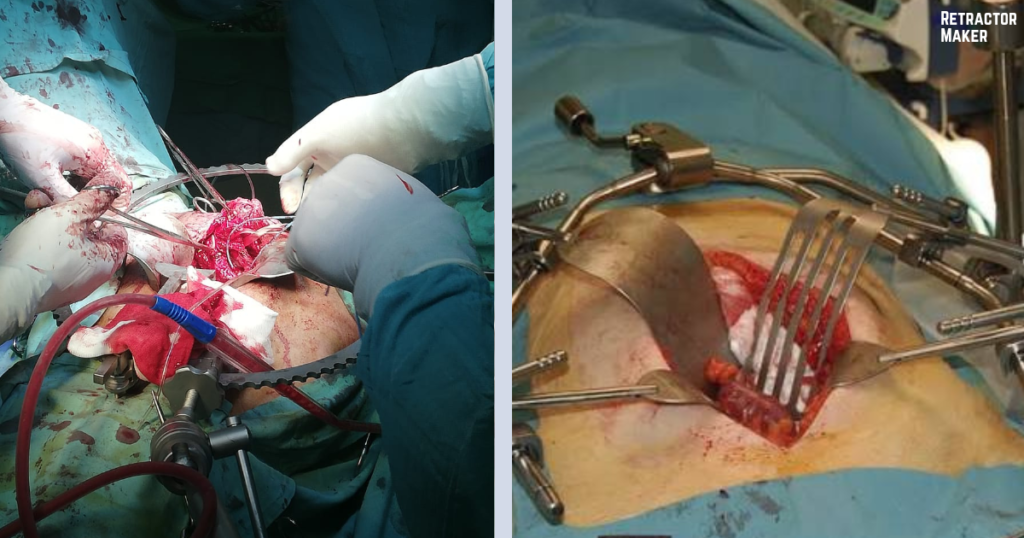
The solid ring of the Bookwalter system (left) resists deflection under heavy lateral loads, while the jointed arms of the Omni system (right) provide multi-angle contouring.
- Bookwalter Stability: The closed-loop ring frame distributes lateral loads evenly around its entire perimeter. When a heavy tissue load is applied to one side of the ring, the opposing side absorbs part of the mechanical stress, preventing localized frame twisting. The solid stainless steel vertical field post prevents system deflection under heavy force.
- Omni Stability: The articulated wishbone frame relies on mechanical friction joints at multiple pivot points. While highly adjustable, multiple joint interfaces can experience slight flex or rotation if subjected to extreme lateral force unless every joint lever is fully tightened.
Surgical Specialties and Clinical Applications
Both retractor platforms excel in specific surgical disciplines based on their structural strengths.
| Surgical Specialty | Bookwalter System Fit | Omni System Fit | Primary Clinical Driver |
| General Surgery | Superior | Good | Midline laparotomies match oval ring track geometry |
| Bariatric Surgery | Superior | Moderate | Rigid single post resists deflection under heavy tissue load |
| Open Urology | Excellent | Excellent | Tilt ratchets vs. articulated flank wishbone access |
| Gynecology & Pelvic | Superior | Good | Segmented rings + deep blades reach presacral space |
| Open Vascular (AAA) | Superior | Good | Continuous non-slip ratchet traction during aortic exposure |
| Pediatric Surgery | Good | Excellent | Fine jointed arms adjust to small, narrow corridors |
Procedures Best Suited for Bookwalter:
- Midline Laparotomies & Colectomies: Oval rings match the longitudinal wound geometry perfectly.
- Bariatric Surgery: Heavy-duty posts and rigid rings maintain exposure against thick subcutaneous adipose layers without flexing.
- Deep Pelvic Surgery (Gynecology/Colorectal): Segmented rings paired with tilt ratchets allow deep blades (e.g., St Marks, Rectal) to reach into the presacral space.
- Open Vascular Surgery: Stable, non-slip ratchet traction provides continuous exposure of abdominal aortic aneurysms (AAA).
Procedures Best Suited for Omni:
- Unilateral Flank Approaches: Articulated wishbone arms fold around one side of the patient for kidney or adrenal access.
- Asymmetrical Subcostal Incisions: Jointed arms shape along the rib margin for complex hepatobiliary procedures.
- Pediatric and Small-Corridor Surgery: Fine articulated arms can be positioned close together for small operative fields.
Cleaning, Storage, and Sterilization Protocols
Central Sterile Processing Departments (CSPD) process retractor systems daily. Equipment complexity directly affects cleaning efficiency and reprocessing safety.
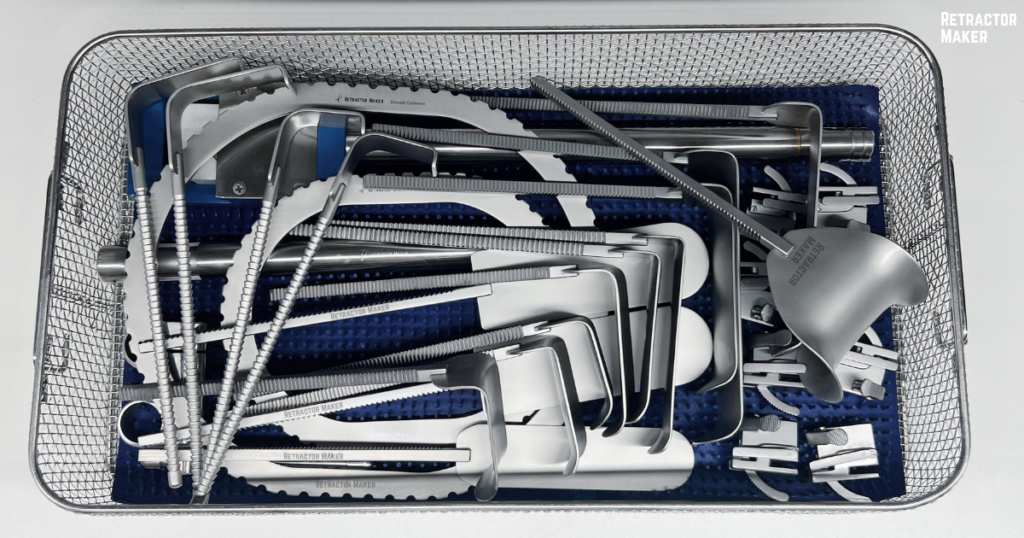
Bookwalter components feature smooth, un-welded surfaces that organize cleanly inside dedicated perforated sterilization trays.
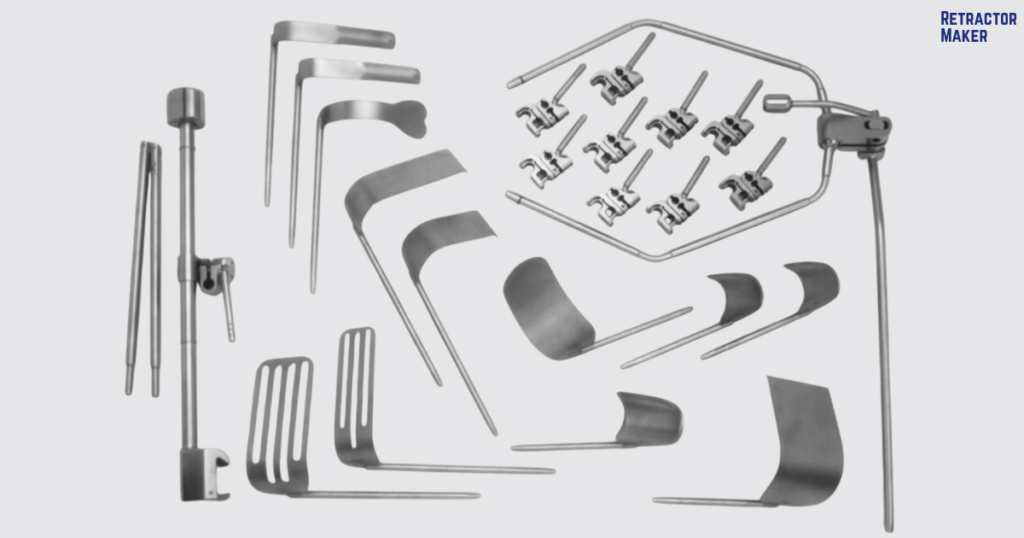
Omni Retractor trays accommodate multiple articulated joints, wishbone arms, and screw-locking blade adapters.
Reprocessing Comparison:
- Bookwalter Reprocessing: Components disassemble into major structural pieces (coupler, post, flex bar, ring, individual ratchets, and blades). Ratchets feature open spring channels that flush easily during automated washing. Perforated trays keep hardware organized for pre-vacuum steam sterilization (134°C / 273°F for 4 to 5 minutes).
- Omni Reprocessing: Requires disassembling multiple threaded thumb screws, pivot joints, and sliding adapters. CSPD staff must ensure that internal threads on blade holders are scrubbed thoroughly to prevent enzymatic buildup inside screw mechanisms.
Side-by-Side Comparison Tables
The following table synthesizes the key technical, clinical, and operational differences between the Bookwalter and Omni retractor platforms.
| Feature / Metric | Bookwalter Retractor System | Omni Retractor System |
| Mounting Architecture | Single-post heavy-duty rail clamp | Dual-post or wishbone mounting framework |
| Primary Frame Geometry | Continuous perimeter ring (Oval, Segmented) | Articulated wishbone arms |
| Blade Locking Mechanism | Spring-loaded notched shank ratchets | Screw-clamp or pin-lock blade holders |
| Average Setup Time | 2 to 3 minutes | 4 to 6 minutes |
| Adjustment Complexity | Low (Single flex bar handle & clip ratchets) | Moderate (Multiple joint levers & thumb screws) |
| Frame Stability Under Force | High (Closed loop ring frame distributes load) | Moderate (Multiple friction joints can flex under heavy load) |
| CSPD Cleaning Simplicity | High (Open ratchet channels, fewer screw threads) | Moderate (Multiple internal thumb-screw threads) |
| Replacement Hardware Fit | Widespread universal industry compatibility | Proprietary manufacturer-specific fit |
Which System Is Better for Your Facility?
Neither system is universally superior; rather, each platform serves specific operational priorities and surgical requirements.
Choose the Bookwalter Retractor System If:
- Your surgical volume centers on general surgery, open laparotomies, bariatric procedures, deep pelvic surgery, and vascular operations.
- Your operating room teams prioritize rapid setup, intuitive ratchet operation, and 360-degree frame stability.
- Your facility wants a highly durable, modular platform with widely available, cost-effective replacement parts and blades.
- Your Central Sterile Processing Department prefers streamlined reprocessing with fewer small threaded fasteners.
Choose the Omni Retractor System If:
- Your surgical department performs a high volume of unilateral flank procedures, complex subcostal approaches, or specialized pediatric operations.
- Your surgeons prefer jointed, highly articulated wishbone arms that shape around non-planar patient torsos.
- Your team prefers screw-locking or pin-shank blade adapters over notched sliding ratchets.
Explore Our Complete Corporate Network
As a specialized global manufacturer of self-retaining surgical retractor systems, our corporate manufacturing network serves healthcare facilities, surgical centers, and medical distributors across multiple specialized surgical domains:
- Retractor Maker — Explore our complete corporate catalog of self-retaining retractor systems, specialized table-mounted systems, and custom OEM manufacturing capabilities across all surgical disciplines.
- Leyla Retractor — Discover our dedicated product line of specialized Leyla neurosurgical retractor systems, flexible holding arms, cranial fixation clamps, and neurosurgical accessories.
Frequently Asked Questions (FAQs)
What is the primary difference between a Bookwalter Retractor and an Omni Retractor?
The primary difference lies in frame structure and blade locking. The Bookwalter uses a single-post vertical mount supporting a continuous 360-degree ring frame with notched ratchet locks. The Omni uses articulated wishbone arms attached to table posts, using screw-clamp or pin-lock blade holders.
Are Bookwalter and Omni retractor blades interchangeable?
No. Standard Bookwalter blades feature flat notched shanks designed to engage spring-loaded ratchets. Omni blades typically utilize cylindrical pin shanks or specialized adapters secured by thumb screws.
Which system is faster to assemble in the operating room?
The Bookwalter Retractor is generally faster to assemble (2 to 3 minutes) because it anchors to a single table post coupler and uses a central flex bar to position the ring frame over the patient.
Which retractor system is better for bariatric surgery?
The Bookwalter Retractor is widely preferred for bariatric operations. Its closed-loop ring frame and heavy-duty field post resist deflection under heavy lateral tissue loads, and it accommodates extra-deep blades (such as Kelly 2″ × 7″ or Big Boy blades).
Can a Bookwalter Retractor be used for lateral or flank procedures?
Yes. Using a Segmented Hinged Ring allows the lateral sides of the Bookwalter frame to fold downward, conforming to flank contours during nephrectomies or retroperitoneal dissections.
How does blade depth adjustment differ between the two systems?
In the Bookwalter system, surgeons pull the notched blade shank outward, and the ratchet locks automatically at each notch. In the Omni system, surgeons adjust blade position manually and tighten a thumb screw or clamping lever to lock it.
What is the purpose of a tilt ratchet in a Bookwalter system?
A tilt ratchet features an internal gear mechanism that allows the attached blade tip to tilt upward or downward, providing vertical tissue lift and deep pelvic exposure while the ring frame remains parallel to the patient’s body.
Are replacement parts widely available for Bookwalter systems?
Yes. Because the Bookwalter architecture uses standardized post dimensions and notched blade shanks, healthcare facilities can source standalone replacement parts—such as ratchets, couplers, flex bars, and blades—from specialized manufacturers like Retractor Maker to maintain existing hospital sets.
How do CSPD cleaning protocols compare between Bookwalter and Omni?
Bookwalter components feature open ratchet channels and fewer threaded fasteners, allowing straightforward enzymatic flushing. Omni components include multiple articulated joints and threaded thumb screws that require meticulous brushing to prevent organic buildup.
Which retractor system is more cost-effective for hospitals?
Bookwalter systems are generally more cost-effective over their lifecycle due to widespread component compatibility, simple modular maintenance, and lower replacement hardware costs compared to proprietary jointed platforms.
Conclusion
Both the Bookwalter Retractor System and the Omni Retractor System represent proven mechanical engineering solutions for open surgical exposure. Selecting the ideal system depends on your facility’s primary procedure mix, surgical preferences, and operational workflow requirements.
For hospitals and surgical centers seeking rigid multi-vector stability, rapid setup, and cost-effective component maintenance across general, urological, gynecological, and vascular operations, the Bookwalter Retractor System remains an industry benchmark.
To explore complete system setups, specialized retractor blades, or standalone replacement hardware, view our full catalog in the Bookwalter Retractors Category or review the primary Bookwalter Retractor System. You can also examine our corporate catalog at Retractor Maker and specialized neurosurgical solutions at Leyla Retractor.
Request Your B2B Quotation
Retractor Maker is a specialized manufacturer supplying factory-direct table-mounted retractor systems, replacement components, and surgical accessories to hospitals, surgical centers, medical distributors, and procurement teams worldwide.
Contact Us — Speak directly with our manufacturing specialists regarding bulk orders or OEM requests.
Request a Quote Now — Receive formal B2B pricing and fulfillment timelines.
Download Product Catalogue — Access complete technical specifications and part lists.